

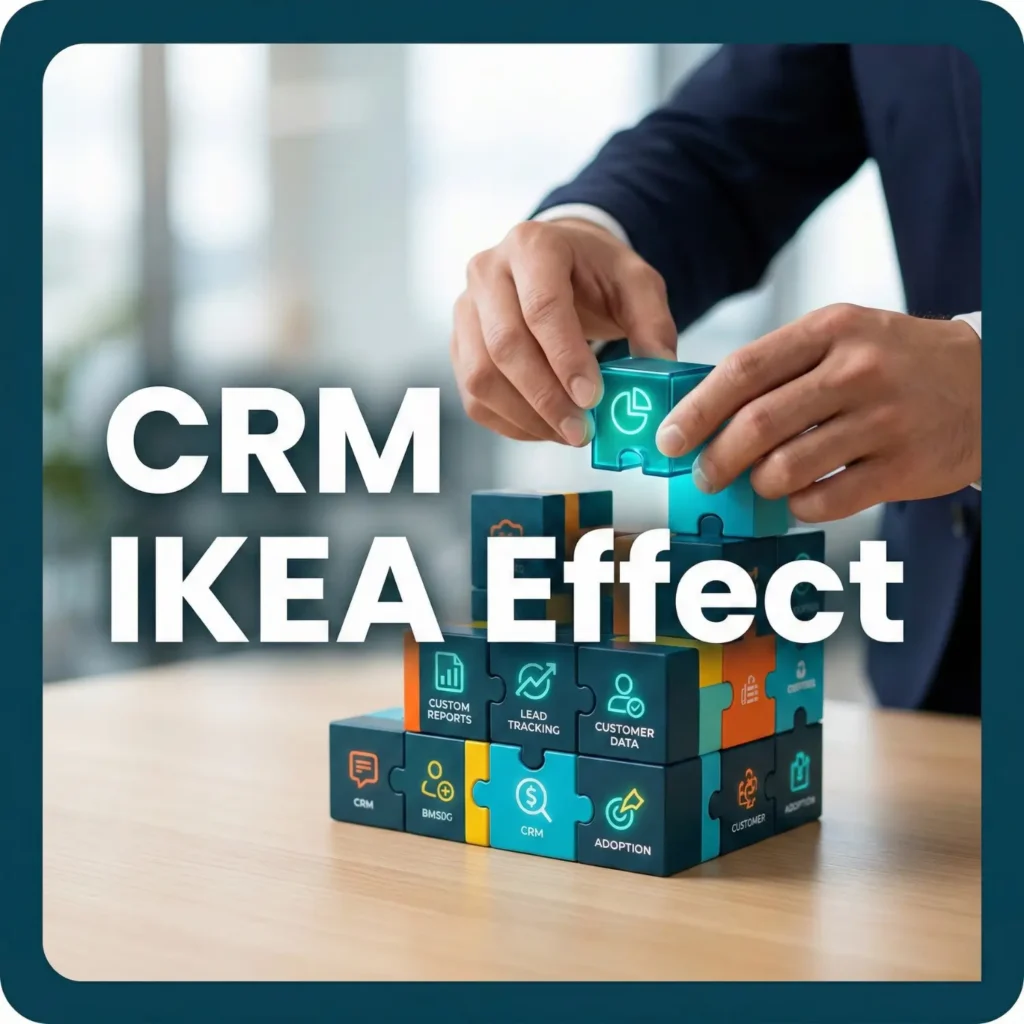
The IKEA Effect refers to the tendency for people to place disproportionately high value on something they help create.
The cognitive bias associated with this effect can positively impact the success of your CRM project.
This post will cover the effect and its application to business software projects.
It’s never advisable to spring the following type of communication on certain long-time or influential employees:
“We’ve implemented a new CRM system. Your login will be emailed to you today. Your training is scheduled for next Wednesday.”
Involvement in the Assembly
With IKEA products, some simple assembly is often required. The ‘effect’ is that people usually value something they assemble themselves.
Reflect on any successful DIY project you’ve completed. You likely feel a sense of pride every time you look at or use your creation.

Michael I. Norton of Harvard Business School wrote in 2011 about the positive effects of IKEA on consumer products.
Today, companies like Shoe Zero allow you to design your own shoes.
The IKEA Effect and Business Software
So, how does this B2C (business-to-consumer) sales-and-marketing revelation apply to business technology purchases, such as CRM?
It involves getting representative end users involved in the requirements definition process.
While end-users will not build the end system, as consumers design their apparel online, their input can be visible in the CRM system when it is rolled out.

End-user input often reflects firsthand experiences of inefficiencies that cause frustration and reduce productivity.
For example, if information is currently complex to locate but could be easily tracked and found in a CRM system, it would make the employee more content and productive.
Or there are recurring processes that would flow much more smoothly with automated task assignments.
According to Norton, in the B2C world, “convincing consumers to engage in the kinds of labor that will lead them to value products more highly, especially given their general aversion to such pursuits,” is a marketing challenge.
Because internal employees are more accessible than external consumers, getting end-users to engage in the assembly process is less challenging.
Many employees will jump at the chance to air their grievances and suggest which processes and features would alleviate them and make CRM more valuable.
The IKEA Effect, also known as ‘pride of authorship,’ is crucial to a successful CRM planning and selection process. This can extend to any enterprise technology in which end-users have a stake.
At CRM Switch, we have helped many medium-sized and enterprise companies determine which employees or employee groups to involve in the CRM strategy, planning, and requirements-gathering process.