

A CRM colleague once said, “The world’s greatest work of fiction is a sales pipeline.”
He was only half kidding. And he was only talking about a symptom of a deeper problem with no solution at the time: a lack of Revenue Intelligence to supplement human effort.

There are only so many hours in a day. ‘Fictional’ forecasts and sales-cycle blind spots stem from sales reps recalling only partial details from each interaction and not always having time or discipline to manually enter what they remember into the CRM.
Accurate forecasting and higher close rates rely on reps noticing or being notified of personnel changes at customer and prospect organizations.
It depends on them noticing subtle shifts in buyer communication.
It even assumes that they’re keeping up with per-account product usage data.
Traditional CRM systems are passive repositories that rely heavily on self-reporting, which leaves critical data scattered across inboxes, call recordings, calendar items, and product usage data.
The results: delayed deals, lost deals, and ‘surprise’ customer churn.
It’s not because of a lack of human intelligence. It’s because of limited time and only partial access to all the signals.
As often happens, when enough organizations face the same problems and the underlying technologies mature, solutions surface in the marketplace.
Revenue Intelligence (RI) platforms live above traditional CRM and other tools, aggregating and interpreting these scattered signals.
The RI space is maturing, with enterprise revenue intelligence platforms like Gong and Salesloft leading the way in transforming raw engagement data into actionable insights. An early-stage mid-market player is looking for pilot organizations.
The technology is reshaping CRM itself. A wave of AI-native CRM platforms are building that same intelligence directly into the system of record. However, switching to one of these systems can be an expensive and time-consuming shift for current Salesforce and HubSpot customers.
One way to explain how an RI platform works is through potential use cases. Here are several examples.
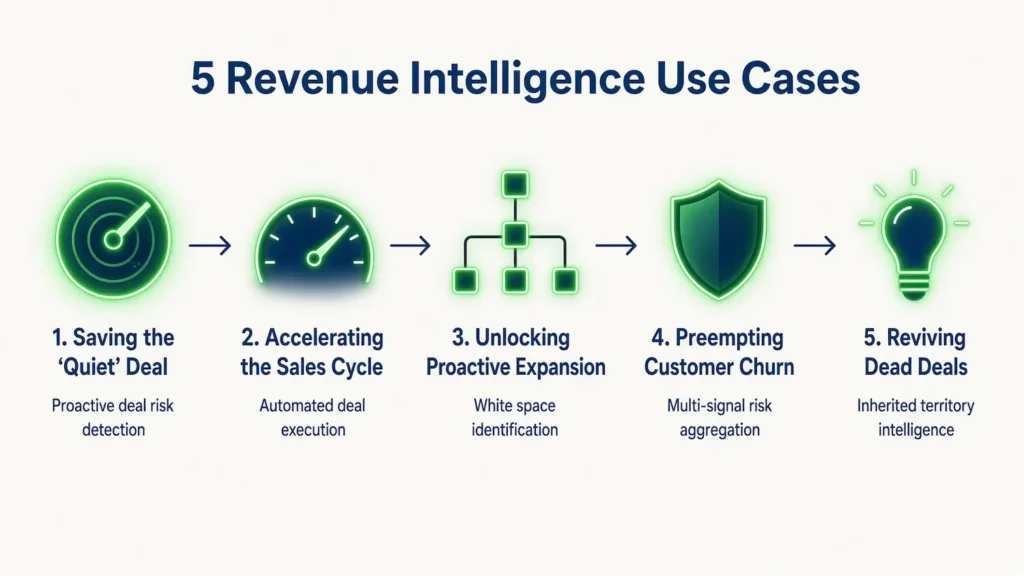
Saving the ‘Quiet’ Deal (Deal Risk Detection)
A deal looks ‘green’ and committed in the CRM, but critical warning signs are invisible to the system.
RI connects the dots: the champion hasn’t replied to emails in twelve days, a cheaper competitor was mentioned three times in recent calls, and the close date hasn’t moved in four months.
Instead of being blindsided when the deal slips or is lost, reps are proactively alerted to re-engage executive sponsors while there is still time to save this quarter’s expected revenue.
Accelerating the Sales Cycle (Automated Deal Execution)
Reps often manually rebuild methodologies like MEDDPICC from memory after hours, frequently missing hidden process bottlenecks.
An RI platform automatically captures process details directly from calls and emails. For example, it can flag that an IT security review was mentioned in passing on a discovery call or an email thread, something that historically adds weeks to a sales cycle.
Based on this information, a sales team can schedule commercial negotiations and security reviews side by side rather than sequentially, accelerating time to close by weeks.
Unlocking Proactive Expansion (White Space Identification)
An existing customer account appears perfectly healthy in the CRM, with no open opportunities and a renewal date months away.
By aggregating product usage data (e.g., active users exceeding purchased licenses) and support communications (e.g., tickets arriving from a new corporate domain), RI identifies a significant, unflagged expansion opportunity.
Account managers can proactively engage the customer with an expansion deal months before the standard renewal conversation is scheduled.
Preempting Customer Churn (Multi-Signal Risk Aggregation)
A major renewal is 90 days out and marked as ‘Green’ in the CRM, but the account is actually a severe flight risk.
RI pieces together subtle negative signals that look like noise in isolation: the original executive sponsor’s email bounced, product usage has dropped by 31% in key regions, and support ticket sentiment is falling due to technical bugs.
The platform flags the renewal as high risk immediately, giving the account team the necessary 90 days to fix the technical issues and build a relationship with the new leadership before the contract expires.
Reviving Dead Deals (Inherited Territory Intelligence)
A new rep inherits a territory filled with ‘Closed Lost – No Decision’ CRM records that contain zero notes or context from the previous owner. It’s a classic case of lost corporate memory: everything the last rep knew about these deals left with them.
RI resurfaces the historical context—such as a call recording from last year showing the deal died due to a missing accounting integration—and pairs it with recent engagement data, like the prospect visiting the pricing page again.
The rep can reopen the conversation with perfect context and timing (e.g., right after the missing feature ships and the prospect’s new budget cycle begins) without having to start from scratch.
What the Numbers Say
Those scenarios are illustrative. Here’s what the research shows so far:
Forecast accuracy: In Forrester’s 2025 Total Economic Impact study of Clari (which has since merged with Salesloft), a $4.5 billion security company cut its forecast miss from 8–9% to 5–6%, even after switching to a harder-to-predict metric. A manufacturer with no formal forecasting process beforehand reached 96% forecast accuracy.
Win rates: Forrester’s 2025 study of Salesloft modeled a 12% lift in closed/won rate (from 10% to 11.2%). In the Clari study, an energy company raised win rates in a struggling segment from 16% to 22%.
Sales cycles: Outreach’s 2025 platform data shows that deals supported by Kaia, its real-time AI coaching assistant, closed 11 days faster on average.
Quota attainment: In a 2024 Gartner survey of 1,026 B2B sellers, sellers who effectively partner with AI tools were 3.7 times more likely to meet quota.
The Forrester studies were commissioned by the vendors (Forrester retains editorial control) and built on interviews with four to six customer decision-makers each. Outreach’s figure comes from its own platform data. Treat these numbers as directional, not guaranteed. Gartner’s survey is independent, though it measures AI tools broadly rather than RI platforms specifically.
Revenue Intelligence turns forecast meetings from interrogation into strategic action. The pipeline is no longer fictional—it’s grounded in relevant, disparate data sources.
The answers are already inside a company’s business data—they are just scattered. RI makes that data retrievable and legible, allowing revenue teams to rely less on CRM data entry and act more on available intelligence.