

Buckle up. Digital transformation is no longer a future conversation. It is already in motion, and most organizations are on the ride whether they planned for it or not.
It shows up as AI experiments, new CRMs, marketing automation, analytics platforms, and a steady stream of tools all promising better insight and faster results.

The real challenge is not the technology itself. The real challenge is direction.
Too many organizations treat digital transformation as the destination. In reality, it is the vehicle. The destination is achieving your business objectives with more clarity, speed, and confidence.
Buckle Up: The Digital Transformation Ride
No organization gets a free pass anymore. Pressure comes from customers who expect seamless experiences, competitors who move fast, and employees who bring new tools in through the side door.
Every solution promises the same things. Faster decisions. Better engagement. More efficiency.
Without a clear destination, all that power just makes the ride bumpier. Tools without intent create activity, not progress. They add motion, but not momentum.
A clear strategic plan puts a destination on the map. It turns digital investments from expensive experiments into force multipliers that actually move the business forward.
Strategy Comes First
Strategy defines where you are going and why it matters. Digital initiatives should exist to support that destination.
When strategy leads, technology choices become easier. When it does not, teams chase shiny objects and call it innovation.
Execution without direction feels productive at first. Over time, it creates confusion, fatigue, and wasted spend.
I often hear, “We do not have time for strategic planning. We need to execute.” In the end, planning does not slow you down. It keeps you from running in circles.
Start With the End in Mind
Building momentum starts with better questions, not better tools. Questions that surface ambition, tension, and possibility.
Consider asking:
- Where do we want to be, and what will it take to get there?
- What excites us and what worries us about our current path?
- What would change if we moved together instead of in many directions?
- Which opportunities deserve our full attention?
These conversations create shared understanding. They also reveal when the current approach is no longer enough.
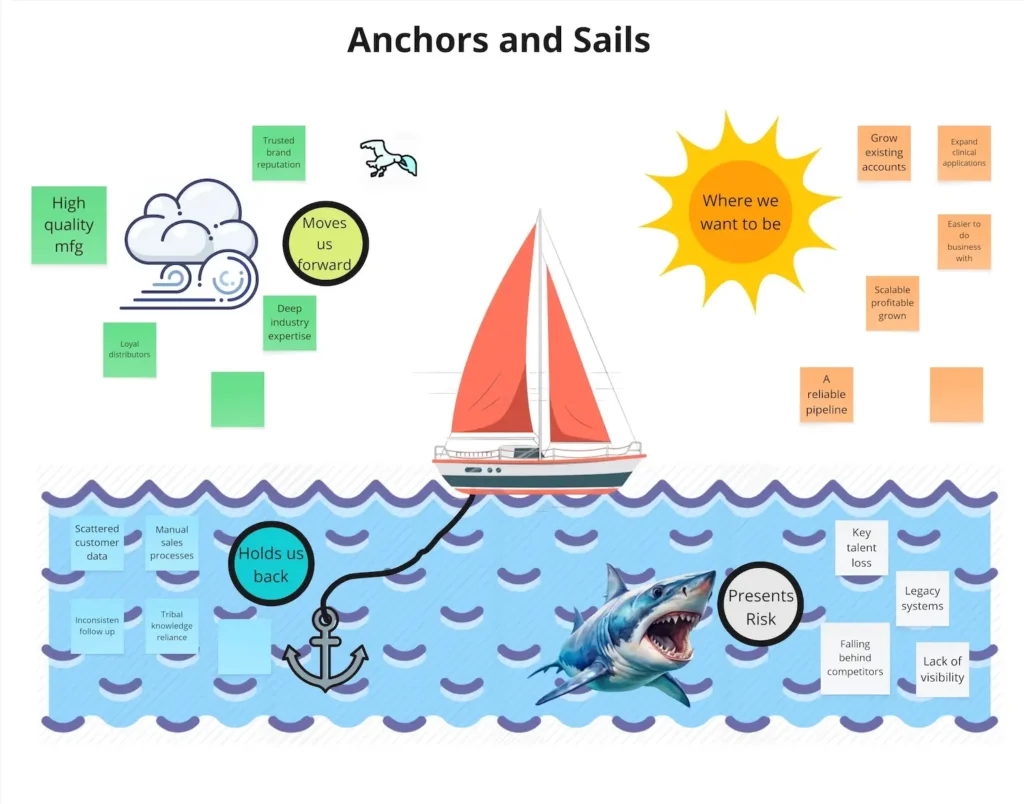
Getting started does not need to be complicated. We often kick things off with a workshop using the Anchors and Sails exercise to surface the most important forces shaping direction early and create a shared lens for technology decisions that follow.
Leadership and the Power of Sponsorship
Strategic planning needs backing. Not casual interest. Real sponsorship.
Someone with influence must open doors and keep the work visible. That person may be the CEO or someone close enough to carry the message.
Digital transformation touches budgets, roles, and priorities. It cannot succeed as a side project.
The captain sets the course. The crew commits when the direction is clear.
What the Process Really Requires
Strategic planning asks busy people to slow down and think. That is often the hardest sell.
It requires time, focus, and honest debate across departments. It also requires leadership participation, not delegation.
The payoff shows up later. Decisions speed up. Trade-offs make sense. Execution feels lighter.
Concrete Deliverables Matter
Belief in strategy often hinges on outcomes people can see and use. Clarity must turn into something tangible.
A strong process delivers:
- A shared vision
- Long-term objectives
- Near-term priorities
- Measurable goals
- Clear KPIs
- A shared lens for making technology decisions that support, not drive, the strategy
Here is the quiet truth. Alignment alone often justifies the investment.
Putting Digital Transformation in Its Place
Once the strategy is clear, digital transformation finds its proper role. It becomes an enabler instead of the headline.
Technology conversations shift. The question is no longer, “Should we adopt this tool?” It becomes, “Does this move the strategy forward?”
AI supports specific outcomes. CRMs reinforce chosen customer experiences. Marketing tools amplify intentional messages.
Technology follows intent. Investment follows clarity.
That is when transformation starts to compound.
Stop Drifting. Start Steering.
Strategic planning is how organizations take control of where they are headed, instead of letting momentum and technology decide for them.
Imagine leaders aligned around a single vision. Imagine teams owning goals that truly matter.
That is not theory. That is execution with purpose.
Strategy and digital transformation belong together. When strategy leads, technology accelerates. When it does not, the ride gets rough.