

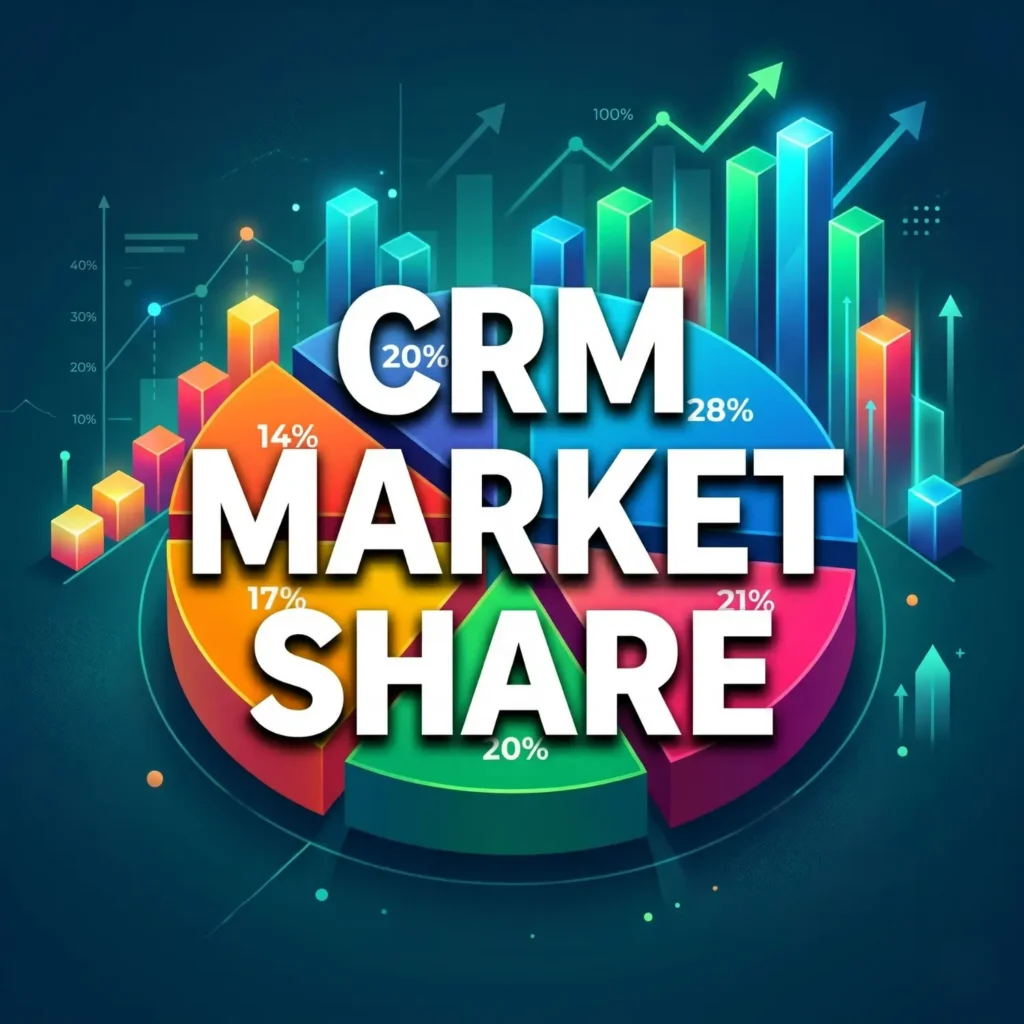
According to IDC’s Worldwide Semiannual Software Tracker (April 2026), which measured the global CRM applications market for 2025, the leading vendors held the following revenue shares:
| Vendor | Market Share (%) |
|---|---|
| Salesforce | 20.0 |
| Oracle | 4.1 |
| Microsoft | 4.0 |
| Adobe | ~3.6 |
| SAP | ~3.1 |
| HubSpot | ~3.0 |
| Zoho | ~3.0 |
| All Others | ~59 |
Salesforce continues to lead the CRM market by a wide margin. Its 2025 CRM revenue was more than four times that of its nearest competitor, and IDC has now ranked Salesforce the #1 CRM vendor worldwide for 13 consecutive years. Salesforce also remains #1 in Sales applications (14 consecutive years), Customer Service (13 years), and Marketing (7 years).
What Changed This Year
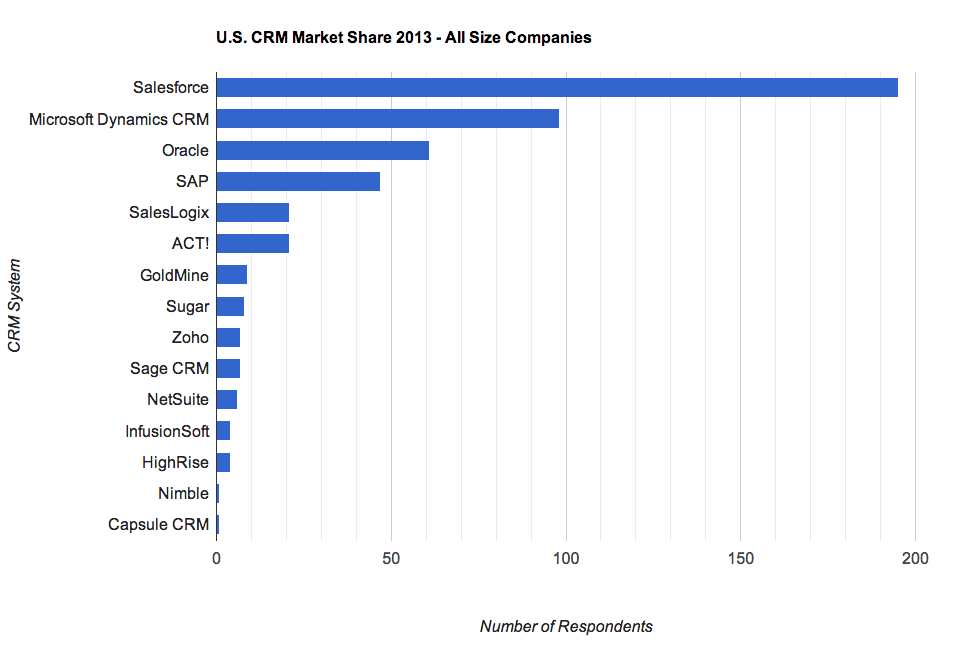
Comparing the newest IDC numbers to last year’s data (and to our original 2013 survey), several shifts stand out:
- Oracle is now the #2 CRM vendor. For years, Microsoft held the clear number-two position, but in 2025, Microsoft’s share fell sharply — from 5.2% to 4.0% — while Oracle held steady at 4.1%, edging ahead. Oracle’s pitch that customers’ back- and middle-office data already lives on its platform (so their CRM and AI should too) appears to be resonating.
- Salesforce’s share slipped again, from 20.7% in 2024 to 20.0% in 2025. As in prior years, this reflects the overall market growing faster than Salesforce, not a decline in Salesforce. Its lead over the field actually widened in relative terms: Salesforce now earns more than four times the CRM revenue of its closest rival.
- IDC began tracking a brand-new category: “Agent Build and Deploy,” covering platforms for building and deploying AI agents. IDC describes the segment as being in a state of hypergrowth. Salesforce grew faster than any other vendor in the category and took the #2 position with a 17.5% share — a sign of how quickly the CRM and AI-agent markets are converging.
- HubSpot keeps compounding. It reached 299,458 paying customers as of Q1 2026 — roughly double Salesforce’s reported 150,000+ — with 2025 revenue of about $3.0 billion (up roughly 18% year over year) and its first GAAP-profitable quarters. Its revenue share still trails the legacy enterprise vendors, but no challenger is growing faster.
- The “All Others” segment keeps expanding — from 46% in 2007 to roughly 59% today. The long tail of niche, vertical, and SMB-focused CRM vendors has gained collective share every year since 2021, though no single vendor in that group has broken past the ~3% mark individually.
Market Size and Growth
The global CRM applications market surpassed $110 billion in 2025 (Fortune Business Insights puts it at $112.9 billion) and is projected to reach roughly $126 billion in 2026. North America remains the largest region, accounting for roughly 32% of global revenue — about $39 billion in 2026.
Longer-term forecasts vary widely by how each firm defines “CRM” — from Grand View Research’s $163 billion by 2030 to Fortune Business Insights’ $321 billion by 2034 — but most analysts project continued double-digit growth (roughly 10–12% annually) through the rest of the decade, driven primarily by generative AI and autonomous agent capabilities.
AI Agents Are Now the Battleground
Last year, every major CRM vendor embedded AI agents into its core product. This year, agents became a measurable market of their own — IDC’s new Agent Build and Deploy category makes that official. Here’s where the major vendors stand:
- Salesforce has made Agentforce the center of its product strategy, with Data 360 (formerly Data Cloud) connecting CRM and backend data to feed its agents. It also acquired m3ter to support consumption-based billing — a sign that AI-agent usage, not seats, is becoming the pricing unit.
- Oracle continues to build out its AI Agent Studio, arguing that agents perform best where CRM sits alongside ERP, HCM, and supply chain data in one Fusion Cloud suite — a message that appears to be winning share.
- Microsoft leans on Copilot across Dynamics 365 and its integrations with Microsoft 365, Teams, and Power Platform, though its CRM market share declined notably in 2025.
- HubSpot has expanded Breeze AI and Breeze Agents platform-wide, emphasizing out-of-the-box usability over heavy configuration — consistent with its mid-market positioning.
- Adobe continues to push Firefly-based agentic tools for marketing personalization through its Customer Experience Cloud.
- SAP ties its Customer Experience suite to operational data through agent-driven journey orchestration.
Disruptors are circling, too. ServiceNow has publicly stated its ambition to become the CRM market leader, leveraging its enterprise workflow strengths, and no-code players like Creatio are extending CRM workflows into the back office. None has cracked the top five yet.
What Buyers Should Take Away
Salesforce remains the safe enterprise default, especially for organizations that want the broadest ecosystem, the deepest AppExchange integrations, and the most mature AI-agent platform.
Oracle deserves a fresh look from organizations already running Oracle ERP or HCM — its rise to #2 reflects a genuinely differentiated data story. Microsoft Dynamics 365 is still the natural choice for organizations standardized on Microsoft 365 and Azure, though its momentum has cooled.
HubSpot continues to win mid-market and growth-stage companies on usability, faster implementation, and lower total cost of ownership. Zoho competes aggressively in the SMB segment on price and breadth of its suite.
The biggest shift since our original 2013 survey isn’t at the top — Salesforce was #1 then and remains #1 now — but in how the rest of the market is being reshaped. The long tail of vendors now holds nearly 60% of the market, the #2 spot changed hands for the first time in years, and the emergence of a distinct AI-agent market means the next generation of CRM competition may be decided less by feature checklists than by whose agents actually do the work.
Note: Market share figures vary across research firms (IDC, Gartner, Statista, and others) depending on how each defines the CRM market. The IDC numbers above include sales force productivity, marketing campaign management, customer service, contact center, advertising, and digital commerce applications. Approximate (~) figures are estimates where IDC did not publicly disclose exact vendor shares.